When a Delta E pass still looks wrong
ISO 12647-2 lets an OK sheet sit 5 ΔE*ab from the aim. The CIEDE2000 figures beside that limit are only informative. A solid can pass both and the picture can still be wrong.
The cyan solid on the OK sheet read 2.8 ΔE00 against the proof. Yellow read 3.1. The press software put a green mark next to both. The buyer's complaint was a face, not a patch: the skin was redder than the proof, and the gray built from cyan, magenta and yellow had gone warm. Nobody was inventing that. The patches and the picture were telling two different truths, and only one of them was on the screen.
If you sign work to ISO 12647-2, you need to know which of those truths the standard actually governs.
The number that counts, and the number that is only a note
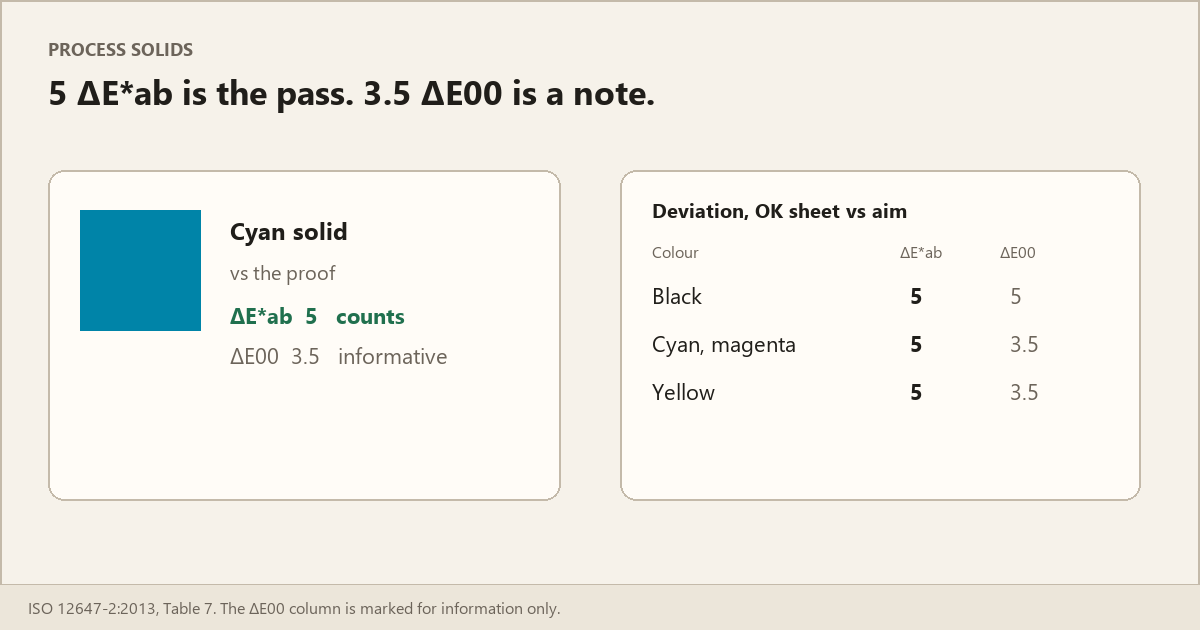
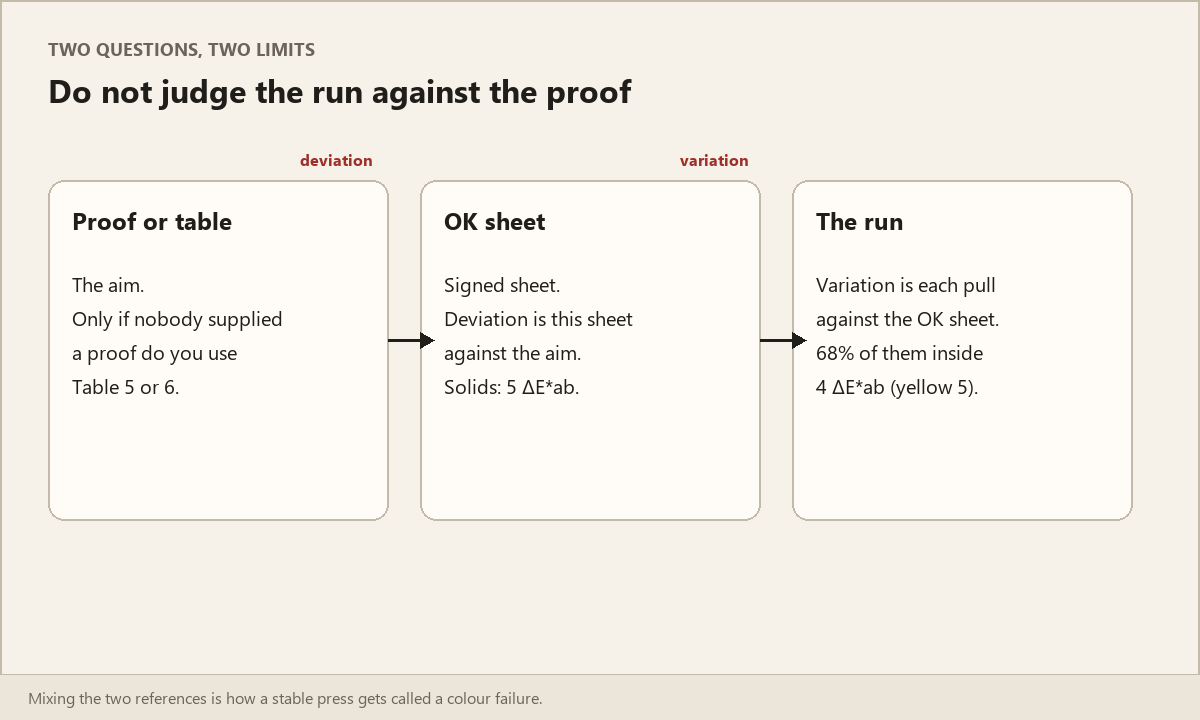
Table 7 of ISO 12647-2:2013 sets the CIELAB tolerances for the four process solids. The deviation column is the OK sheet against the aim. The aim is the proof, when a conforming proof or a characterised data set was supplied. If nobody supplied one, the aim falls back to the colour values in Tables 5 and 6. The variation column is the rest of the run against that OK sheet, and it is not a limit on every single pull. For a conforming run, at least 68 percent of the sampled sheets have to sit inside it.
| Solid | Deviation ΔE*ab | Deviation ΔE00 | Variation ΔE*ab | Variation ΔE00 |
|---|---|---|---|---|
| Black | 5 | 5 | 4 | 4 |
| Cyan | 5 | 3.5 | 4 | 2.8 |
| Magenta | 5 | 3.5 | 4 | 2.8 |
| Yellow | 5 | 3.5 | 5 | 3.5 |
The footnote under that table is the part people skip. The ΔE00 values are given for information. They are not the normative pass. The normative pass is ΔEab, and it is 5 for every solid on deviation. A sheet at 4.2 ΔE00 and 4.6 ΔEab has cleared the informative number's spirit and the normative number's letter. A sheet at 3.2 ΔE00 and 5.4 ΔEab has done the opposite: the screen can look friendly while the quantity the standard uses has already failed. Read the column the contract names. If the contract just says "ISO", the column that binds is ΔEab.
Hue is in the same table, on the variation side, for the three chromatic colours. ΔH is capped at 3. Black has no hue tolerance in that cell, because black's hue is not the thing that walks. A cyan that stays inside ΔE*ab and swings in hue will still shift a sky and a steel gray. The composite number hides that. If the software will show ΔH, look at it before you add ink to "correct" a patch that is already inside 5.
Yellow's variation window is wider than the others: 5 ΔEab, where cyan, magenta and black are held to 4. That is in the table on purpose. It is also why a cream background can look dirty while yellow is still "in." A 4.5 ΔEab movement in yellow from the OK sheet is inside the variation tolerance and perfectly able to spoil a pale tint. The tolerance is a process limit. It is not a promise that the design will survive it.
Do not judge the run against the proof
This is the mix-up that makes a stable press look like a colour failure.
Deviation is one question: is the signed sheet close enough to the aim? Variation is a different question: is today's pull close enough to the sheet we signed? The second question uses the OK sheet as its reference, not the proof. Once that sheet is signed, a pull that sits 3 ΔE*ab from the OK sheet and 6 from the proof can be inside variation and outside deviation at the same time. Reporting it as "the colour moved" depends entirely on which reference you kept in the instrument.
The 68 percent rule cuts the other way. The standard does not say every sheet in the pile is inside 4. It says 68 percent of the samples are. A plant that rejects any pull over 4 is running tighter than ISO, which is a commercial choice and often a sensible one. It should be described that way. Calling a single sheet at 4.2 a breach of ISO 12647-2 is not what clause 4.3.2.3 says.
Solids are also the wrong patch for a lot of the complaints that arrive with a ΔE printout. Note 4 in the ink-colour section says it plainly enough: the secondary colours depend on ink sequence, trapping, rheology and the paper surface, and the standard does not offer one tolerance window that covers both the solids and the overprints. Red, green and blue can move while cyan, magenta and yellow solids stay put. A face is mostly those overprints, plus whatever black was added. A green light on four solid patches does not speak for the face.
The picture lives in the midtones
Gray balance is a tone-value problem more often than it is a solid problem. The coated sheet-fed curve in Table 8 aims the 50 percent patch at 16 percent tone-value increase. Table 11 lets the OK sheet sit 4 percentage points either side of a midtone aim, so a 50 percent patch reading anywhere from 12 to 20 is inside the deviation tolerance. Mid-tone spread, the gap between the highest and lowest tone-value increase of cyan, magenta and yellow, is capped at 5 points.
That is a wide door. A cyan midtone that is 4 points heavy and a yellow midtone that is 4 points light will each pass, and the gray built from the three of them will go blue-green or warm depending on which way you were unlucky. Adding cyan ink to fix it moves the solid, which was fine, and often leaves the shadow where it was. The first place to look is the tone curve and the spread, not the solid ΔE.
Two measurement habits make this worse.
The backing. Thin stock reads differently over white and over black. The conformance notes allow either, and they do not allow you to compare them in one argument. If the proof was measured on white and the press bar is on a black-backed instrument, the difference you are looking at includes the board.
The light. ISO 13655 splits the measurement into modes. M0 is the old tungsten condition, with the ultraviolet left uncontrolled. M1 is D50 with the UV included, which is the mode behind FOGRA51 and the right one for a coated sheet that contains optical brightener. M2 cuts the UV out and ignores the brightener. The same cyan patch produces different numbers under those three. None of the three is "more ISO" in the abstract. The number is only comparable with an aim that was built in the same mode. FOGRA51 aims are M1. Reading them with an instrument left on M2, then debating the ink, is a debate about the lamp.
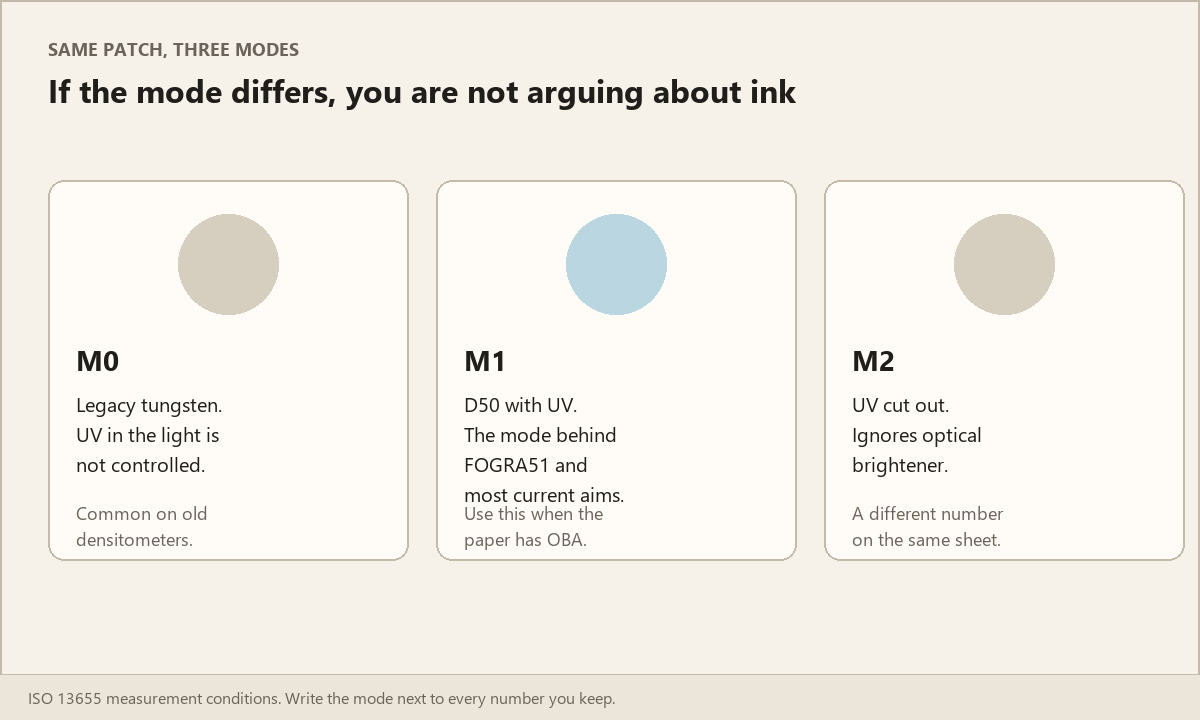
Write the mode next to the number. A ΔE with no M0, M1 or M2 beside it is an unfinished measurement. So is a number with no backing, and a number with no reference. "4.1" is not a result. "4.1 ΔE*ab, M1, white backing, OK sheet against the proof" is a result.
Finishing, and the booth
A matte film or an overprint varnish moves the colour and the gloss after the OK sheet was signed. The standard says so, in a note: surface finishing can shift the result enough that the unfinished sheet is a poor guide to the finished one. If the contract is for the laminated carton, measure a laminated sheet, or agree in advance that the signature is on the unlaminated one. Do not discover the film at goods-in.
The viewing booth is the other silent variable. A D50 booth and a cool office LED are different lights. A pair of inks that match under one can split under the other. That split is metamerism, and no ΔE computed from a single measurement condition will predict it. If the argument only exists in the buyer's office, go and stand in the office. The patch on the press console cannot settle a difference that appears when the lamp changes.
Density still has a job
Density is a bad way to match a proof from another plant. It is a good way to hold a run once the OK sheet exists. The usual practice, and the one the standard's notes describe, is to get the solids to the right colour first, then read the densities off that signed sheet and hold those densities for the rest of the run. The density target belongs to that ink, that paper and that instrument. A density brought across from a different stock, or typed into the console because it was the density on last month's job, is not an ISO aim. ISO aims are colorimetric.
So the order at the console, when the lights and the eyes disagree, is short.
Use one instrument, one mode, one backing, and a patch rather than a picture area. Decide whether the question is deviation or variation before you touch a key. If the solids pass and the picture does not, open the tone values and the mid-tone spread before you add ink. If yellow is inside the informative ΔE00 and a pale tint still looks wrong, believe the sheet. And if the only record of the measurement is a single number, measure it again and write the mode down. The second reading takes a minute. The argument it prevents takes the rest of the morning.