Why a barcode scans but fails the verifier
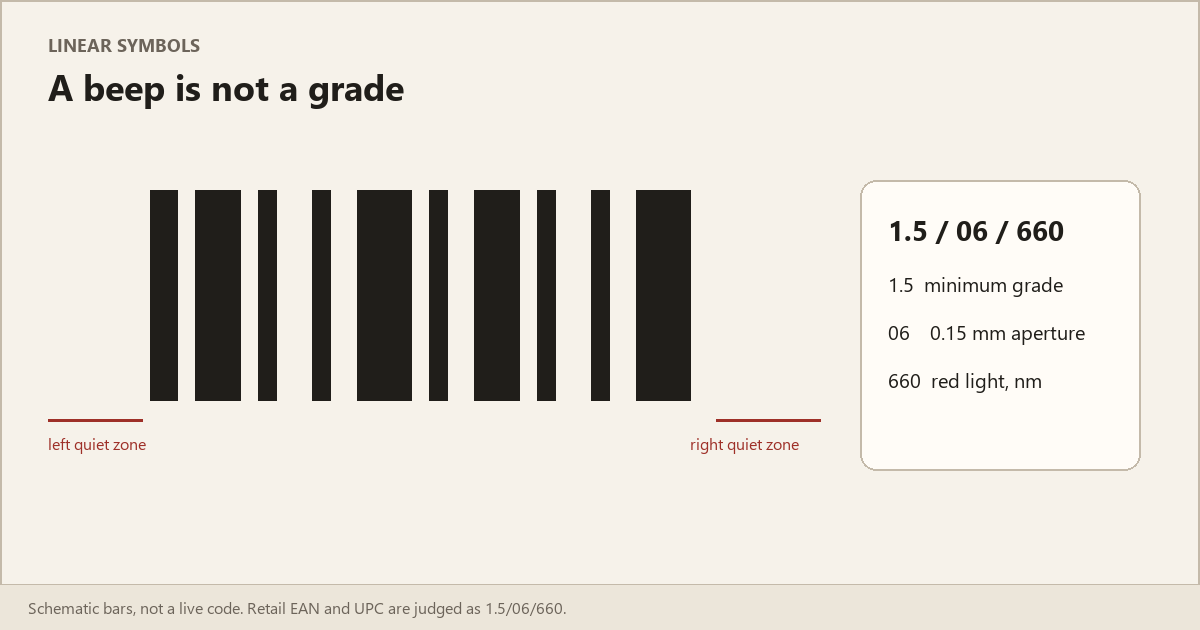
Retail EAN and UPC symbols are held to 1.5/06/660 under ISO/IEC 15416. A phone that beeps has not measured aperture, wavelength or quiet zone, so it cannot clear the symbol.
The rejection arrived as two attachments. One was a photograph of a phone, taken in the office, with the EAN-13 in frame and a caption that said the code scans. The other was a verifier report: 1.2/06/660, with the quiet zone on the right marked short. The symbol was black, printed on a kraft-coloured panel of a folding carton, and someone had tucked a cut guide into the space beside the last bar so the code would fit the flap.
The phone was not lying. The verifier was not lying. They were not doing the same test.
A beep is not a measurement
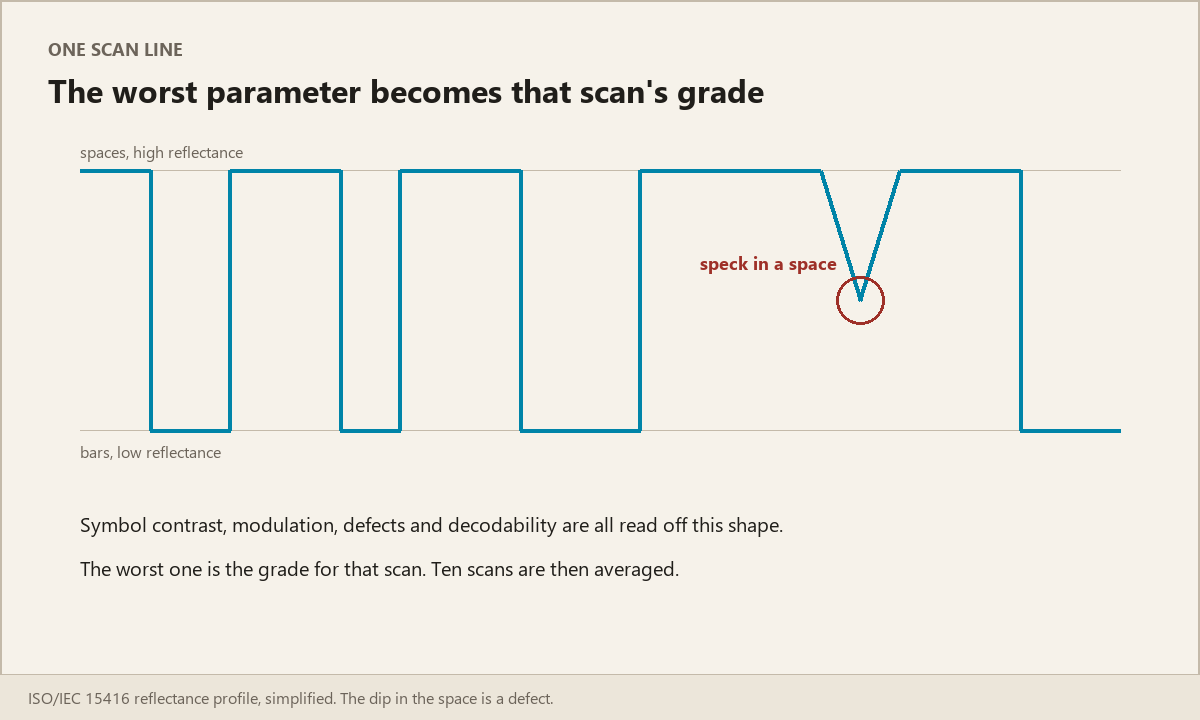
ISO/IEC 15416 is the method for a linear symbol. A verifier scans the bars on at least ten lines spread through the height of the code. Each line is graded on several parameters, and that scan receives the grade of its worst parameter. The overall grade is the arithmetic mean of those scan grades, reported to one decimal place, on a scale from 4.0 down to 0.0.
The parameters are decode, symbol contrast, minimum reflectance, edge contrast, modulation, defects and decodability. Contrast asks whether the bars are dark enough and the spaces light enough. Modulation asks whether the narrow spaces still reach up toward the wide ones, or whether ink spread has filled them in. Defects are voids in a bar and specks in a space. Decodability asks whether the bars and spaces still have the widths the symbology expects. Decode is the pass or fail underneath all of that: if the scan cannot be turned back into the digits, the rest of the grades do not rescue it.
Letter grades are the same scale with older names. From 3.5 to 4.0 is an A, 2.5 to 3.4 a B, 1.5 to 2.4 a C, 0.5 to 1.4 a D, and below that an F. The retail minimum of 1.5 sits at the bottom of C, not in a gap between C and D. A report that says "C" and a report that says "1.5" can be the same result or a full grade apart, because C covers everything from 1.5 to 2.4. Ask for the numeric grade.
The average is where a single bad scan gets misunderstood. Nine scans at 2.0 and one scan at 0.0 average to 1.8, which still clears 1.5. The symbol passes, and it passes with a scar. Five scans at 2.0 and five at 1.0 land on 1.5 exactly. A defect that repeats in the direction of print, a blade line, a filled-in space that runs the whole height of the code, hits every scan. Then the average falls with them. One speck and a repeating speck are different failures, and the report's individual scan grades show which one you have. An overall number with the ten scans thrown away is half a report.
How to read 1.5/06/660
GS1 writes the requirement as three pieces, because a grade without the other two cannot be compared with anything.
The first piece is the minimum overall grade, here 1.5. The second is the measuring aperture in thousandths of an inch. 06 is a 6 mil aperture, 0.15 mm. The third is the wavelength of the light in nanometres. 660 is red, and the usual allowance is 10 nm either side. Older verifier menus sometimes say 670. A 660 result and a 670 result are close, and they are not the same measurement. Compare like with like.
For an EAN or UPC that will be scanned at a retail checkout, the GS1 minimum is 1.5/06/660. A GS1-128 used on a logistics label, and an ITF-14 printed on a label rather than directly on board, is generally 1.5/10/660: same grade, larger aperture, 0.25 mm. An ITF-14 printed straight onto corrugate, with an X-dimension of 0.635 mm or more, is allowed down to 0.5/20/660. The coarse code and the rough board cannot be held to the aperture you would use on a magazine cover. Using the retail aperture on that corrugate code makes every speck look worse than the specification intended. Using the 20 mil aperture on a retail EAN blurs the narrow spaces and pulls modulation down. An impressive grade measured with the wrong hole in front of the receiver is not a grade you can send to the retailer.
Why the phone keeps saying yes
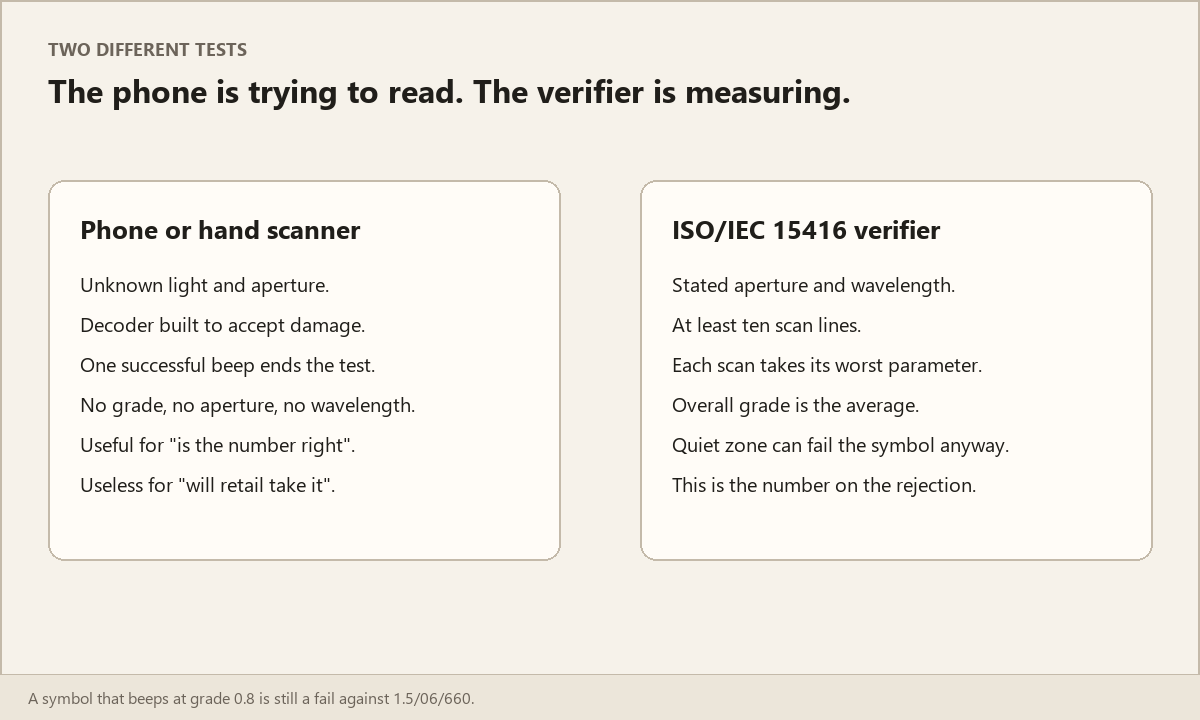
A phone camera, and most hand scanners on the warehouse bench, are built to recover a damaged symbol and return the digits. The light is whatever the room has. The aperture is whatever the lens happens to be doing. The test ends at the first successful decode. There is no grade, because a grade was never the point.
That is the right tool for one question: are these the digits we encoded? It is the wrong tool for the question the retailer is asking, which is whether the symbol will keep decoding on their scanners after printing, packing and a year in a shop. A symbol at 0.8 will often beep in an office. Against 1.5/06/660 it has already failed. Sending the photograph of the phone as a rebuttal tells the buyer you measured a different thing.
The verifier is dull on purpose. It does not hunt for a threshold that works. It records the reflectance along the scan, grades the shape, and averages the scans. If you want the argument to stop, both sides have to be looking at that report.
Quiet zone, bar growth, and the board
The right-hand quiet zone was the actual failure on the carton, and it never needed a spectrophotometer.
An EAN-13 at 100 percent magnification has a module, the X-dimension, of 0.330 mm. The quiet zone on the left is 11 modules, about 3.6 mm. The quiet zone on the right is 7 modules, about 2.3 mm. Nothing goes in that space. Not a box rule, not a cut guide, not the edge of a coloured panel. The guide that was moved into the flap to "make the code fit" is the failure. A hand scanner can be placed so that it ignores the intrusion. The specification cannot.
Bar growth fails a different parameter. If the bars gain and the spaces shrink, decodability and modulation fall while the digits may still read. On offset, that gain comes from ink and from the black tone curve. On flexo it comes from impression and from the plate. The file can be built at the nominal module and still arrive fat, because the press adds width the encoder did not know about. Leaving no spare, and then scaling the finished code sideways in the layout program so it fits a box, changes the ratio of bars to spaces. Generate the symbol at the size it will be printed. Do not stretch it afterwards.
The kraft panel fails a third way. Symbol contrast needs dark bars and light spaces. Black on a brown board is often short of contrast no matter how sharp the edges are. More ink makes the bars blacker and does very little for a space that was never white. The fix is a white under-print, larger than the symbol by the quiet zone, printed solid. A four-color black is the wrong ink for the bars themselves. Registration error between cyan, magenta, yellow and black turns every edge into a coloured fringe and lowers the contrast the verifier is about to measure. One black. Not a rich black.
Varnish and film change the result again. A gloss coating can fill narrow spaces and drop contrast. A grade measured on the sheet before finishing is not the grade of the pack the retailer receives. Verify the finished pack, at the aperture and wavelength written on the order. If the order does not name them, name them yourself and send 1.5/06/660 rather than a naked 1.5. A grade with no aperture is an invitation to test it again under a harsher one.
What to change before the reprint
Look at the worst parameter on the report before you change the press. The parameter tells you which of these you actually have.
If contrast is the worst number, the board or the ink colour is the problem. White under the code, a darker single black, or both. Adding impression will not paint the spaces white.
If modulation or decodability is the worst number and contrast is fine, the bars are heavy or the spaces are closing up. Take ink off, or impression off, and check that the file was not scaled after it was generated. A tone curve that pushes the black midtones will fatten a bar the same way too much ink does.
If defects are the worst number on every scan, look for something that repeats: a dirty plate, a blade line, a particle that prints in the same place down the form. If only one or two scans are bad, it may be a single speck, and the average may already be carrying it. Clean the cause anyway. The next job will not be as lucky with the average.
If the quiet zone is called out, stop looking at the press. The art is wrong, or the die is wrong, or someone added a rule. No density change repairs a space that has been printed on.
Two-dimensional codes are a different method. Data Matrix and QR are graded under ISO/IEC 15415, not 15416. A linear verifier setup, even a careful one, does not answer that question. Retailers who ask for a 2D symbol next to the EAN are asking for a second test, with its own aperture. Running the linear grade and calling it the QR grade is the same mistake as photographing the phone.
The useful file to send back with a disputed carton is short. The overall grade, the aperture, the wavelength, the worst parameter, and whether the quiet zone passed. Plus one sentence on what was changed. "It scans in the office" is not one of those fields.