How to Distinguish Plate Bounce Bars from Anilox Roller Bars
Plate bounce bars have a large spacing, equal to the pitch of the impact on the plate cylinder, and often start from the leading edge of a solid area. Anilox roller bars are fine and dense, continuous across the entire web, and their spacing matches the anilox roller rather than the plate cylinder. First measure the spacing; whichever one it matches, inspect that one. Do not remove both rollers at the same time.
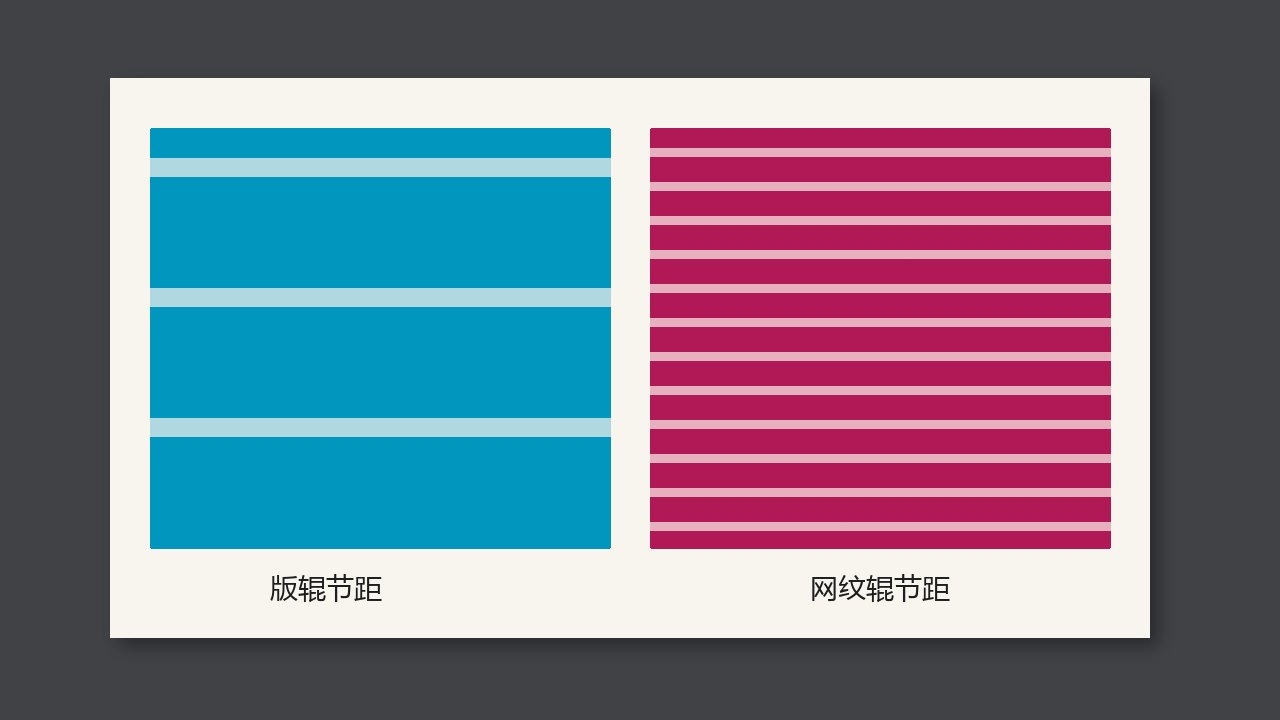
Plate bounce bars have a wide spacing, equal to the pitch of that impact on the plate cylinder, and often start at the leading edge of a solid. Anilox roll bars are fine and dense, continuous across the entire width, with spacing matching the anilox roll rather than the plate cylinder. Measure the spacing first: whichever it matches, inspect that one. Do not remove both rolls at once.
Sources of the two types of bars
Plate bounce occurs when a hard leading edge on the plate hits the impression, the cylinder rebounds, leaving a light band behind, and the next hard edge does it again. So it is often related to the starting position of solids and color patches, while a blank revolution has none. Anilox roll bars come from the anilox roll itself: impact damage, dried ink, or bearings. The bars are fine, and they are present around the entire circumference whether or not there is a leading edge of a solid.
When measuring, still use center-to-center distance. The pitch of plate bounce is usually much greater than the spacing of those fine lines on the anilox roll. If you only say “there are bars” without giving the spacing, the two repair methods will get in each other’s way.
Which one it matches
| Appearance of bars | Relation to solid leading edge | Check first |
|---|---|---|
| Wide spacing, one after another | Often appears after the leading edge | Plate cylinder runout, gear backlash, pressure |
| Fine, dense, continuous across the full width | Unrelated to image starting point | Anilox roll surface and bearings |
| Spacing equals gear pitch | Uniform around the circumference | Treat as gear bars, not surface damage on these two rolls |
Do this first this round
- Measure the center-to-center distance, write it down, then compare it with the plate cylinder circumference and anilox roll circumference.
- For those that only appear after solids, check pressure and gear backlash first. Do not replace the anilox roll first.
- For fine lines around the entire circumference, wash the anilox roll first. If washing does not remove them, check the surface of that roll.