How far off register is still a pass
The 2013 offset standard puts the largest gap between any two colours at 0.10 mm. On small reversed type that tenth is already a dirty fringe, and a mark at the gripper does not speak for the tail.
A buyer was standing at the delivery of a 70 by 100 cm sheetfed, 150 gsm gloss coated, 175 lpi, and he had a loupe on a 6 pt white knockout. The knockout sat in a four-color build. Cyan and magenta were not on top of each other. You could see a colored fringe on the left of the letters and a second fringe, the other way, on the right. The operator had already looked at the register mark beside the gripper and called it a pass. Both of them were describing a real sheet. They were not describing the same place on it.
That argument is usually about one number, 0.10 mm, and almost nobody in the room has the sentence the number comes from.
What the clause actually says
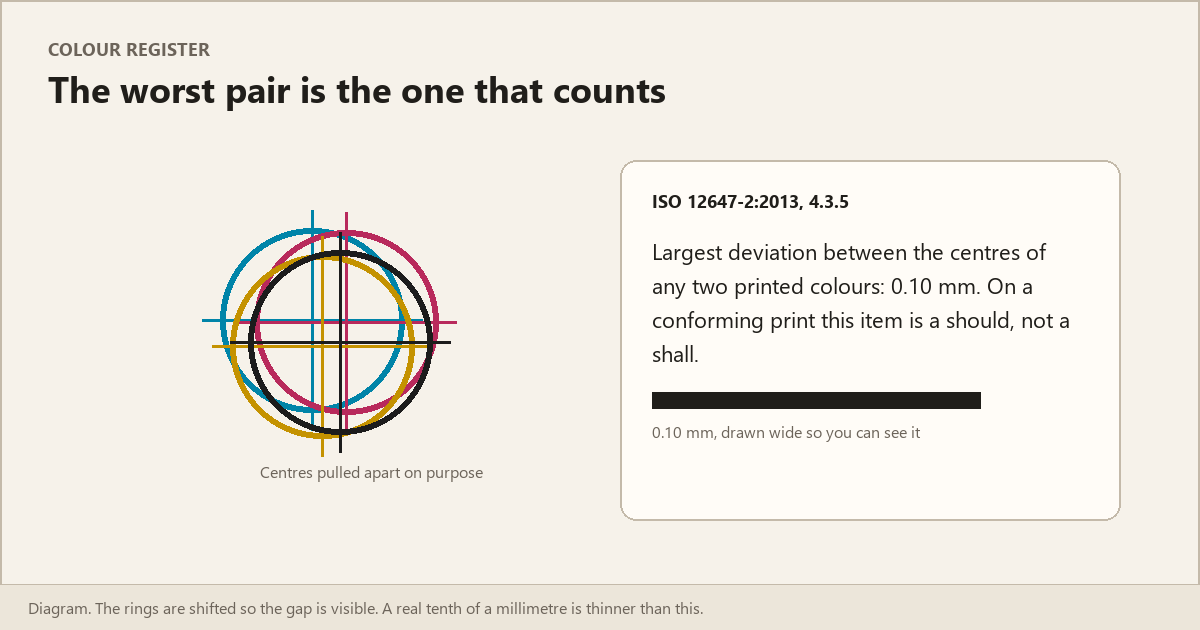
ISO 12647-2:2013, clause 4.3.5, says the average of the colour-register centres shall not exceed 0.10 mm as the largest deviation between any two printed colours. Two words in that sentence do more work than the tenth of a millimetre.
"Any two" means the worst pair. Cyan against black can be tight while magenta against yellow is not, and the magenta-yellow pair is the result. Averaging the good pairs in with the bad one is not what the clause asks for. "Largest" is doing the same job. If you only read the mark that happens to look best, you have not measured the sheet.
The same document then does something that surprises people who have only ever been told "ISO says a tenth." In the conformance clause, 4.3.6, a conforming print shall meet the control strip, the solid ink colours, and the tone-value increase and mid-tone spread. Image positioning is listed under the items a conforming print should meet. The tolerance is written as a shall inside its own clause, and as a should when the standard decides what makes a print conforming. A buyer can still put 0.10 mm into a purchase order and make it a hard fail. The standard, on its own, treats register as recommended and treats the solids and the tone curve as required. If someone waves "ISO" at a register dispute, ask which of those two sentences they mean.
The previous edition was stricter on some work and looser on the rest. The 2004 text limited the maximum deviation between image centres to 0.08 mm on middle-format presses with paper above 65 g/m², and 0.12 mm otherwise. Shops that grew up on that edition still say "eight hundredths" as if the standard had not moved. On a heavy coated sheet the 2013 number is slightly looser than the one they remember. On a light web stock it is slightly tighter. Quoting the tenth without saying which edition, and which clause, is how two plants certify the same job to two different rules.
A tenth against a row of dots
At 175 lines per inch, one row of dots is 1/175 inch, which is 0.145 mm. Half a row is about 0.07 mm. The shop rule "no more than half a row" is tighter than 0.10 mm, and it is a reasonable rule for commercial sheetfed on coated paper. It is not the ISO number. If the ticket says half a row, measure half a row. If the ticket says ISO 12647-2:2013, the figure written in 4.3.5 is 0.10 mm, and even that is in the "should" list for conformance.
The mark in the margin is only useful if you know how wide its strokes were drawn. A lot of commercial register marks are stroked at about that same tenth. While the colours sit on top of each other you see one stroke. When a pair splits by the width of the stroke, paper shows through as a light line. That line is not a suggestion to go and find a camera. It is the limit, already, for a mark drawn at 0.10 mm.
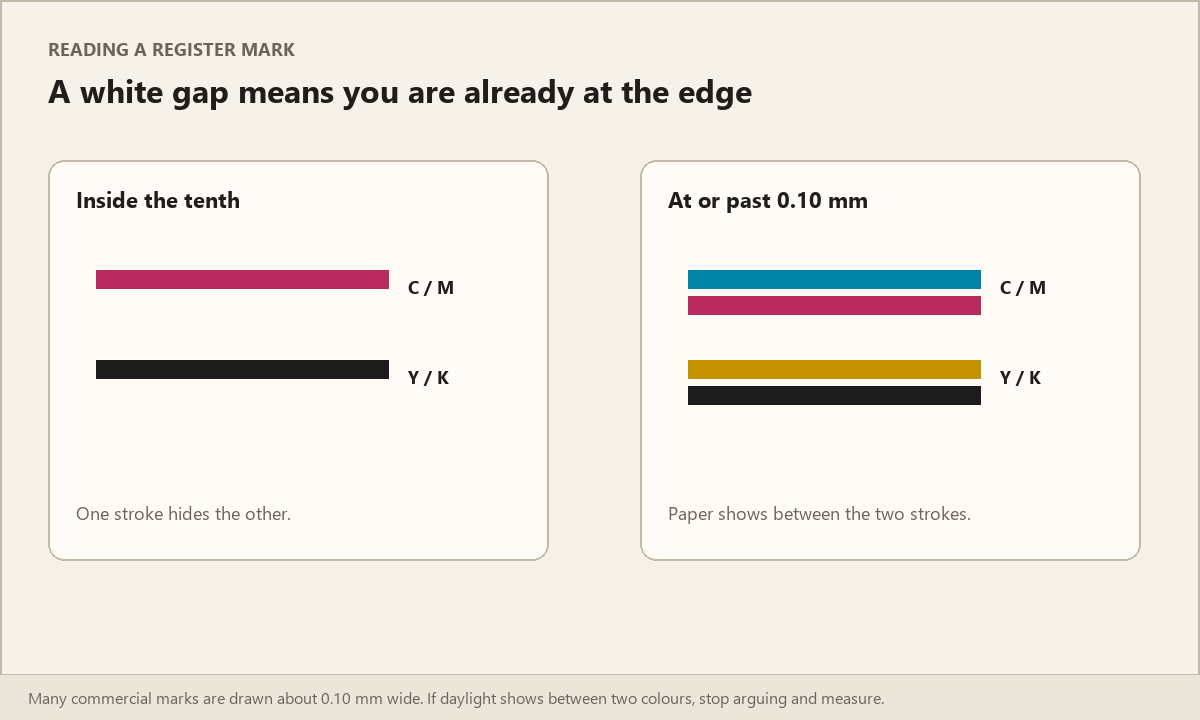
A vernier on the mark, or the register camera if the press has one, will give you the number without the argument about stroke width. Read the worst pair. Then walk the sheet. A camera pointed only at the mark by the gripper is a camera pointed at the easy end.
The gripper can pass while the tail fails
On a sheetfed offset press the sheet picks up water as it goes through the units. Across the cylinder, the dimensions change. The usual name for the result is fan-out: the colours, which fitted at the lead edge, walk apart toward the tail. Circumferential error is a different animal. That one comes from packing and from print length, and it shows along the direction of travel rather than across it. Lateral error, side to side, is the side lay or a plate that has been cocked.
These do not get solved by the same adjustment. Cocking a plate will take a twist out. It will not take a bow out, and it will not stop a tail that gets worse from the first pull to the last. Adding packing under a blanket changes print length. People reach for it when the error is actually a plate that was bent out of square, and then they spend the rest of the make-ready chasing a length they just created.
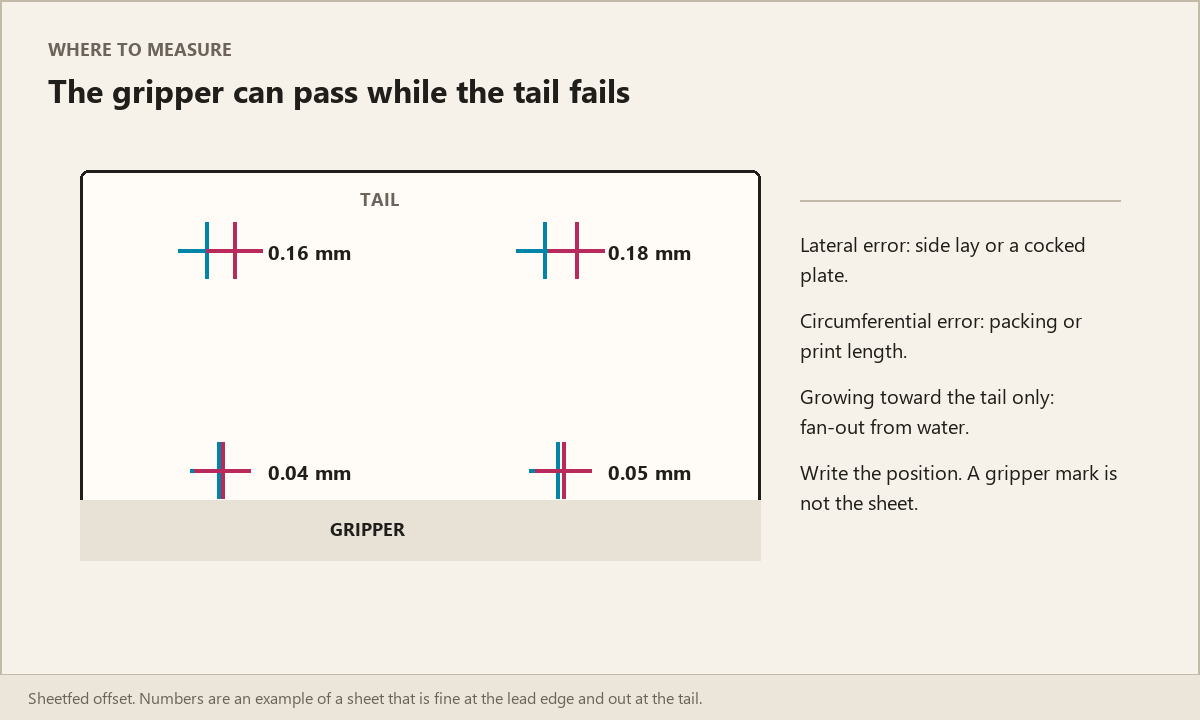
The numbers on that sketch are one sheet, not a tolerance. They are there because this is the sheet that starts the fight: the mark the operator checked is inside 0.05 mm, and the knockout the buyer is looking at, two thirds of the way to the tail, is closer to 0.16 mm. Nothing is wrong with either observation. The sheet is not one number.
Write the position down. Gripper, tail, gear side, operator side. A single reading with no position on it cannot be compared with the next pull, and it cannot be defended when the job comes back.
Where a tenth is already too much
0.10 mm is a ceiling for process control on offset. It is a poor ceiling for some of the work that actually gets printed.
Reversed type under about 8 pt, sitting in a rich four-color build, shows a fringe well before the mark in the margin looks dramatic. A 0.15 mm keyline does too. So does a flesh tone with a cyan edge that the instrument would still call a tenth and the eye calls dirt. The standard is not wrong for having a single process number. The number was never a promise that every design would look acceptable at the limit. If the design cannot live with a tenth, the ticket has to say so before the plates are made. Discovering it at the delivery, with a buyer and a loupe, is the expensive version of the same fact.
There is a second place the offset tenth does not belong. It does not travel onto a flexo label press or a gravure unit just because the file was approved against an offset proof. Those processes have their own documents. Pasting 0.10 mm into a flexo report because it was the only register number anyone could remember is how a label plant gets blamed for missing a tolerance that was never written for the process.
One more thing the mark will not save you from: a barcode, a small logo, or a fine rule built out of more than one ink. Register then becomes part of the product, not part of the margin. Split the art so that anything which fails when two colours move is drawn in one colour. That is a prepress decision. No amount of careful side-lay work will make a two-color hairline as stable as a one-color hairline.
What to move, and what to leave alone
Work in an order. Most of the time lost on register is someone adjusting the third cause of the error before they have looked at the first.
Look at the plates before you look at the press. A set that was imaged together and bent in the same bender should share its diagonals. The old film rule was that diagonals on a set in equilibrium should not differ by more than 0.02 percent. Plates still move when one of them is bent off square. If the error is the same on every pull and it looks like a twist, the plate is the first suspect, not the ink.
Then the lays. Side lay for a lateral shift that is even from gripper to tail. Head lay, and the head stops, for a circumferential shift that is even across the sheet. Cock the plate only for a twist. Do not cock it to hide fan-out.
If the gripper is stable through the run and the tail keeps growing, leave the plates alone. That pattern is water. Cut dampening back until the plate still stays clean, and look at the grain and the coating of the stock. Adding ink to "cover" a register fringe makes the fringe darker. It does not put the colours back on top of each other.
Do not chase 0.02 mm on a press that is moving 0.08 mm between the first good sheet and the last. The run has to hold. A perfect mark on the pass sheet, followed by a tail that drifts for the next two thousand, is a fail that the pass sheet was never going to catch. Pull sheets from the run, not only from make-ready, and read the same positions you wrote down the first time.
For the record that goes with the job, three lines are enough. The worst pair of colours. The position on the sheet. Whether that reading held from the first signed sheet to a sheet taken near the end. A register camera printout with no position on it is a picture of a mark. It is not a picture of the job.